 3.0.0
3.0.0
|
 |
Loading...
Searching...
No Matches
|
3.0.0
|
|
#include <Eigen/Core>#include <cmath>#include <vector>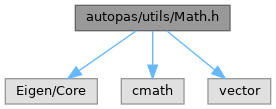

Go to the source code of this file.
Classes | |
| struct | autopas::utils::Math::internal::int_t_impl< FloatType > |
| Helper struct to get the correspondingly sized integer for a given floating type. More... | |
Namespaces | |
| namespace | autopas |
| This is the main namespace of AutoPas. | |
| namespace | autopas::utils |
| In this namespace some helper classes and functions can be found used inside of AutoPas. | |
Typedefs | |
| template<std::floating_point FloatType> | |
| using | autopas::utils::Math::int_t = typename internal::int_t_impl< FloatType >::type |
| Returns the correspondingly sized integer type for a given float. | |
Functions | |
| template<class Int_t , std::enable_if_t< std::is_integral_v< Int_t >, bool > = true> | |
| Int_t | autopas::utils::Math::safeAdd (const Int_t &a, const Int_t &b, const Int_t &valUnderflow=std::numeric_limits< Int_t >::min(), const Int_t &valOverflow=std::numeric_limits< Int_t >::max()) |
| Addition function for integer types that is safe against over and underflow. | |
| template<class Float_t , std::enable_if_t< std::is_floating_point_v< Float_t >, bool > = true> | |
| Float_t | autopas::utils::Math::safeAdd (const Float_t &a, const Float_t &b, const Float_t &valUnderflow=-std::numeric_limits< Float_t >::max(), const Float_t &valOverflow=std::numeric_limits< Float_t >::max()) |
| Addition function for floating point types that is safe against over and underflow. | |
| template<class Int_t , std::enable_if_t< std::is_integral_v< Int_t >, bool > = true> | |
| Int_t | autopas::utils::Math::safeSub (const Int_t &a, const Int_t &b, const Int_t &valUnderflow=std::numeric_limits< Int_t >::min(), const Int_t &valOverflow=std::numeric_limits< Int_t >::max()) |
| Subtraction function for integer types that is safe against over and underflow. | |
| template<class Float_t , std::enable_if_t< std::is_floating_point_v< Float_t >, bool > = true> | |
| Float_t | autopas::utils::Math::safeSub (const Float_t &a, const Float_t &b, const Float_t &valUnderflow=-std::numeric_limits< Float_t >::max(), const Float_t &valOverflow=std::numeric_limits< Float_t >::max()) |
| Addition function for floating point types that is safe against over and underflow. | |
| template<class Int_t , std::enable_if_t< std::is_integral_v< Int_t >, bool > = true> | |
| Int_t | autopas::utils::Math::safeMul (const Int_t &a, const Int_t &b, const Int_t &valUnderflow=std::numeric_limits< Int_t >::min(), const Int_t &valOverflow=std::numeric_limits< Int_t >::max()) |
| Multiplication function for integer types that is safe against over and underflow. | |
| template<class Float_t , std::enable_if_t< std::is_floating_point_v< Float_t >, bool > = true> | |
| Float_t | autopas::utils::Math::safeMul (const Float_t &a, const Float_t &b, const Float_t &valUnderflow=-std::numeric_limits< Float_t >::max(), const Float_t &valOverflow=std::numeric_limits< Float_t >::max()) |
| Multiplication function for floating point types that is safe against over and underflow. | |
| template<size_t exponent, class T > | |
| T | autopas::utils::Math::pow (const T &base) |
| No-overhead power function with exponent known at compile time. | |
| double | autopas::utils::Math::normalPDF (double x) |
| Probability density function PDF of the standard normal distribution. | |
| double | autopas::utils::Math::normalCDF (double x) |
| Cumulative distribution function CDF of the standard normal distribution. | |
| double | autopas::utils::Math::sigmoid (double x) |
| Sigmoid logistic function. | |
| template<std::floating_point FloatType> | |
| bool | autopas::utils::Math::isInUlp (FloatType lhs, FloatType rhs, unsigned int ulpDistance=MAX_ULP_DISTANCE) |
| Function for comparing closeness of two floating point numbers using ULP (Units in the Last Place) method. | |
| template<std::floating_point FloatType> | |
| bool | autopas::utils::Math::isNearRel (FloatType a, FloatType b, double maxRelativeDifference=EPSILON_RELATIVE_EQUALITY) |
| Determines if two doubles are near each other. | |
| template<std::floating_point FloatType> | |
| bool | autopas::utils::Math::isNearAbs (FloatType a, FloatType b, double maxAbsoluteDifference) |
| Determines if two doubles are near each other. | |
| double | autopas::utils::Math::roundFixed (double d, int fixedPrecision) |
| Round a floating point number to a given number of decimal digits. | |
| double | autopas::utils::Math::roundFloating (double d, int floatingPrecision) |
| Round a floating point number to a given floating precision. | |
| Eigen::VectorXd | autopas::utils::Math::makeVectorXd (const std::vector< double > &elements) |
| Create a vector of doubles from given elements. | |
| Eigen::VectorXi | autopas::utils::Math::makeVectorXi (const std::vector< int > &elements) |
| Create a vector of ints from given elements. | |
Variables | |
| const double | autopas::utils::Math::normalScale = 1. / std::sqrt(2 * M_PI) |
| Factor of PDF of standard normal distribution. | |
| constexpr double | autopas::utils::Math::EPSILON_RELATIVE_EQUALITY = 1e-9 |
This default relative EPSILON used for the isNearRel function. | |
| constexpr unsigned int | autopas::utils::Math::MAX_ULP_DISTANCE = 4 |
| The default maximal allowed ULP (Units in the Last Place) distance utilized for FloatingPoint comparisons. | |
| template<typename T > | |
| constexpr size_t | autopas::utils::Math::internal::bit_size_v = sizeof(T) * 8 |
| Helper to find out the bit size of a given type. | |
| using autopas::utils::Math::int_t = typedef typename internal::int_t_impl<FloatType>::type |
Returns the correspondingly sized integer type for a given float.
E.g. int_t of float would be int32_t.
| bool autopas::utils::Math::isInUlp | ( | FloatType | lhs, |
| FloatType | rhs, | ||
| unsigned int | ulpDistance = MAX_ULP_DISTANCE |
||
| ) |
Function for comparing closeness of two floating point numbers using ULP (Units in the Last Place) method.
| FloatType | must be either double or float |
| lhs | The left hand side floating point number to compare. |
| rhs | The right hand side floating point number to compare. |
| ulpDistance | The maximum acceptable ULP distance between the two floating points for which they would be considered near each other, defaults to autopas::utils::Math::MAX_ULP_DISTANCE |
| bool autopas::utils::Math::isNearAbs | ( | FloatType | a, |
| FloatType | b, | ||
| double | maxAbsoluteDifference | ||
| ) |
Determines if two doubles are near each other.
This function should be preferred to comparing with ==.
| a | |
| b | |
| maxAbsoluteDifference | inclusive |
| bool autopas::utils::Math::isNearRel | ( | FloatType | a, |
| FloatType | b, | ||
| double | maxRelativeDifference = EPSILON_RELATIVE_EQUALITY |
||
| ) |
Determines if two doubles are near each other.
This function should be preferred to comparing with ==.
| a | |
| b | |
| maxRelativeDifference | inclusive, relative to max(|a|, |b|), defaults to autopas::utils::Math::EPSILON_RELATIVE_EQUALITY |
| Eigen::VectorXd autopas::utils::Math::makeVectorXd | ( | const std::vector< double > & | elements | ) |
Create a vector of doubles from given elements.
| elements |
| Eigen::VectorXi autopas::utils::Math::makeVectorXi | ( | const std::vector< int > & | elements | ) |
Create a vector of ints from given elements.
| elements |
| double autopas::utils::Math::normalCDF | ( | double | x | ) |
Cumulative distribution function CDF of the standard normal distribution.
| x |
| double autopas::utils::Math::normalPDF | ( | double | x | ) |
Probability density function PDF of the standard normal distribution.
| x |
| T autopas::utils::Math::pow | ( | const T & | base | ) |
No-overhead power function with exponent known at compile time.
| exponent | |
| T |
| base |
| double autopas::utils::Math::roundFixed | ( | double | d, |
| int | fixedPrecision | ||
| ) |
Round a floating point number to a given number of decimal digits.
| d | Number to round. |
| fixedPrecision | Number of decimal digits. Negative values lead to rounding of digits left of the decimal. |
| double autopas::utils::Math::roundFloating | ( | double | d, |
| int | floatingPrecision | ||
| ) |
Round a floating point number to a given floating precision.
| d | Number to round. |
| floatingPrecision | Number of significant digits. Values <0 will return in 0. |
| Float_t autopas::utils::Math::safeAdd | ( | const Float_t & | a, |
| const Float_t & | b, | ||
| const Float_t & | valUnderflow = -std::numeric_limits<Float_t>::max(), |
||
| const Float_t & | valOverflow = std::numeric_limits<Float_t>::max() |
||
| ) |
Addition function for floating point types that is safe against over and underflow.
If over or underflow is detected, the function returns the specified values.
| Float_t |
| a | |
| b | |
| valUnderflow | Return value in case of underflow. |
| valOverflow | Return value in case of overflow. |
| Int_t autopas::utils::Math::safeAdd | ( | const Int_t & | a, |
| const Int_t & | b, | ||
| const Int_t & | valUnderflow = std::numeric_limits<Int_t>::min(), |
||
| const Int_t & | valOverflow = std::numeric_limits<Int_t>::max() |
||
| ) |
Addition function for integer types that is safe against over and underflow.
If over or underflow is detected, the function returns the specified values.
| Int_t |
| a | |
| b | |
| valUnderflow | Return value in case of underflow. |
| valOverflow | Return value in case of overflow. |
| Float_t autopas::utils::Math::safeMul | ( | const Float_t & | a, |
| const Float_t & | b, | ||
| const Float_t & | valUnderflow = -std::numeric_limits<Float_t>::max(), |
||
| const Float_t & | valOverflow = std::numeric_limits<Float_t>::max() |
||
| ) |
Multiplication function for floating point types that is safe against over and underflow.
If over or underflow is detected, the function returns the specified values.
| Float_t |
| a | |
| b | |
| valUnderflow | Return value in case of underflow. |
| valOverflow | Return value in case of overflow. |
| Int_t autopas::utils::Math::safeMul | ( | const Int_t & | a, |
| const Int_t & | b, | ||
| const Int_t & | valUnderflow = std::numeric_limits<Int_t>::min(), |
||
| const Int_t & | valOverflow = std::numeric_limits<Int_t>::max() |
||
| ) |
Multiplication function for integer types that is safe against over and underflow.
If over or underflow is detected, the function returns the specified values.
| Int_t |
| a | |
| b | |
| valUnderflow | Return value in case of underflow. |
| valOverflow | Return value in case of overflow. |
| Float_t autopas::utils::Math::safeSub | ( | const Float_t & | a, |
| const Float_t & | b, | ||
| const Float_t & | valUnderflow = -std::numeric_limits<Float_t>::max(), |
||
| const Float_t & | valOverflow = std::numeric_limits<Float_t>::max() |
||
| ) |
Addition function for floating point types that is safe against over and underflow.
If over or underflow is detected, the function returns the specified values.
| Float_t |
| a | |
| b | |
| valUnderflow | Return value in case of underflow. |
| valOverflow | Return value in case of overflow. |
| Int_t autopas::utils::Math::safeSub | ( | const Int_t & | a, |
| const Int_t & | b, | ||
| const Int_t & | valUnderflow = std::numeric_limits<Int_t>::min(), |
||
| const Int_t & | valOverflow = std::numeric_limits<Int_t>::max() |
||
| ) |
Subtraction function for integer types that is safe against over and underflow.
If over or underflow is detected, the function returns the specified values.
| Int_t |
| a | |
| b | |
| valUnderflow | Return value in case of underflow. |
| valOverflow | Return value in case of overflow. |
| double autopas::utils::Math::sigmoid | ( | double | x | ) |
Sigmoid logistic function.
| x |
|
constexpr |
Helper to find out the bit size of a given type.
| T | any type T |
|
constexpr |
The default maximal allowed ULP (Units in the Last Place) distance utilized for FloatingPoint comparisons.
This is also the value utilized in GoogleTest for their DoubleEq() and FloatEq() Matchers.
 1.9.7
1.9.7